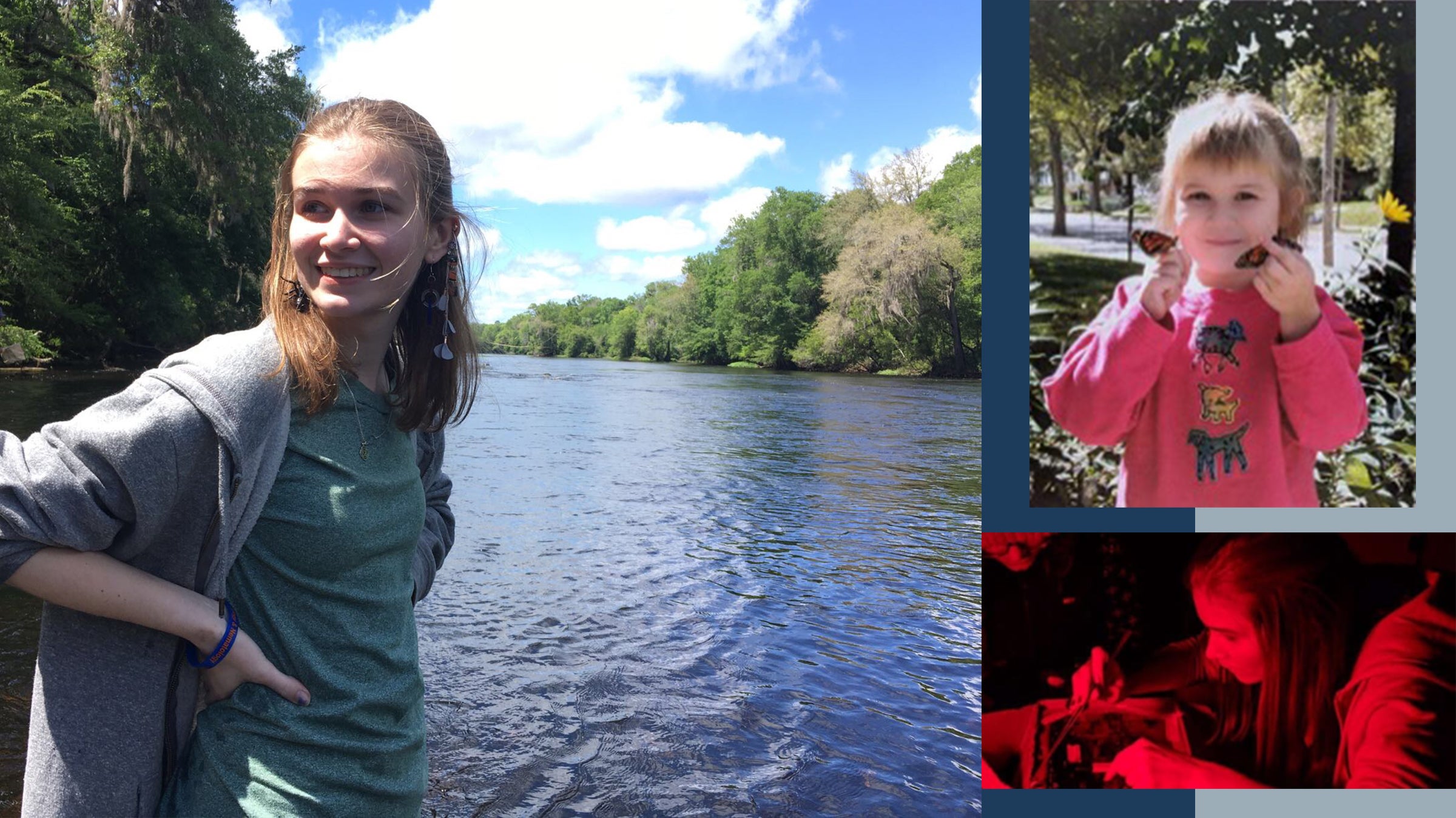
Top right: Young Leeah with monarch butterflies. Bottom right: Leeah pulling bumblebees from their colony under red light as bees are not able to see into the red spectrum of light.
Tell us where you came from before UT, and what you studied then?
I have always loved insects. As a child I wanted to be an insect veterinarian doing tiny insect surgeries, but figured that was an impractical goal when I realized that my classmates loved insects a lot less than I did. In second grade I learned the word ‘entomologist’ and broadened my career aspirations to just hoping to work with insects in some way. This eventually led me to pursue my Bachelor of Science with a major in entomology from Cornell University. This was a wonderful opportunity to gain experience in a lot of different types of research, from curatorial work in the insect collection with Geometrid moths, to high speed filming mayflies in flight, to conducting behavioral assays with jumping spiders.
Eventually, I ended up working as an undergraduate lab assistant with bees, which included lab based work on the interactive effects of pesticides, along with field work on many aspects of the pollinators involved in strawberry pollination. As a part of that project, we removed wax from bumblebee colonies for pesticide residue analysis, but since we had so much extra material I was able to adapt a technique for extracting pollen from wax museum statues to look at colony level pollen collection across these sites as an undergraduate senior thesis project. This project broadly showed that these bumblebee colonies did not collect very much strawberry pollen, which corresponded with the low bumblebee visitation to the strawberry flowers we observed, but also that variation in pollen collection is influenced by which alternative resources are present in the surrounding landscape.
Ultimately, my intrinsic interest in how insects function and interact with their environments, combined with my positive experience working with pollinators led me to pursue a PhD at UT Austin in the Jha & Muth labs studying bee behavior and how bees are impacted by environmental stressors.
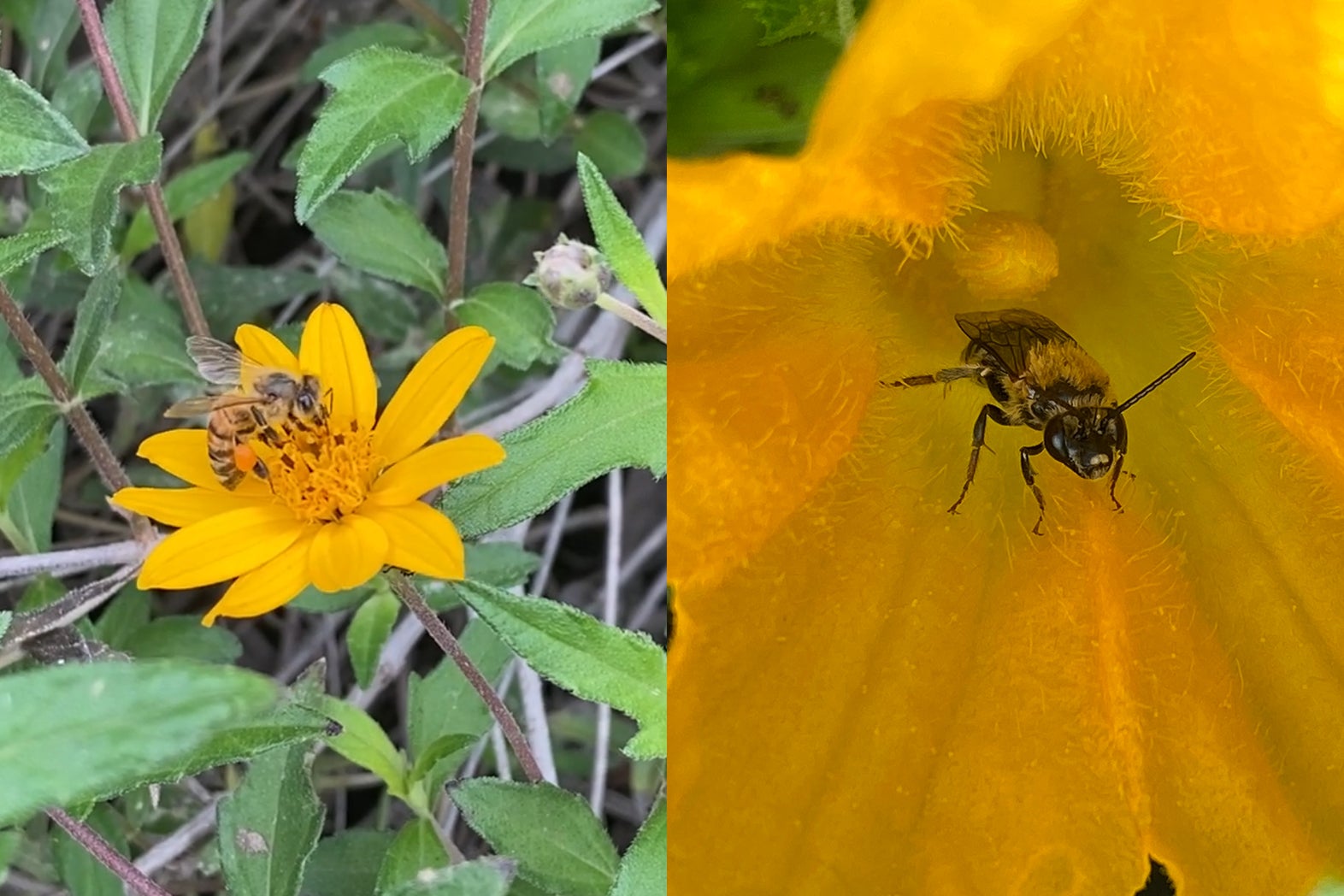
Left: honeybee (Apis mellifera). Right: a specialist squash bee (Xenoglossa pruinosa)
You study bee ecology and behavior. Can you elaborate a bit on this and tell us how you got interested in this?
Spending a lot of hours watching bees land on strawberry flowers for two summers definitely got me interested in bee diversity and how they interact with the plants they pollinate. Bee diversity is impressive, with 4,000 species in North America alone, and there is so little known about the vast majority of these species.
Because of a long history of work with honeybees there is so much foundational research on how bees learn about floral traits like colors and scents. This means a lot of basic experimental tools have been developed, so it is possible to answer very mechanistic questions when working with them. There is also the benefit that bees contribute a lot economically via the pollination services they provide to crops so it’s also possible to do research with real relevance to peoples’ livelihoods and to food security.
As someone interested in basic principles in cognition but also wanting opportunities to do applied work I don’t think there’s a better group to study! Additionally, I think it would be wrong to neglect to mention that they really are so charismatic (fluffy, shiny, colorful; what’s not to love?).
My dissertation has two major themes: sublethal effects of insecticides, and comparative cognition. For both aspects of my dissertation I am excited about incorporating lab based bumblebee work and work with wild bees. Altogether, I’m aiming to link ecological roles, neural investment, and anthropogenic stressors to bee behavior and reproduction.
Does Texas present a unique situation, challenge or benefit for your research?
Texas presents a lot of unique benefits to studying bees! So much of the land here is privately owned, which can make biodiversity research challenging for many taxa, but the association bees have with agriculture and how responsive they are to different types of land use means there’s a lot of really interesting work to be done when collaborating with the people who manage these lands.
It also matters that applied research is done with stakeholders whenever possible, not just about them. Working directly with land managers builds that connection into the science itself, ultimately making the work stronger and more valuable.
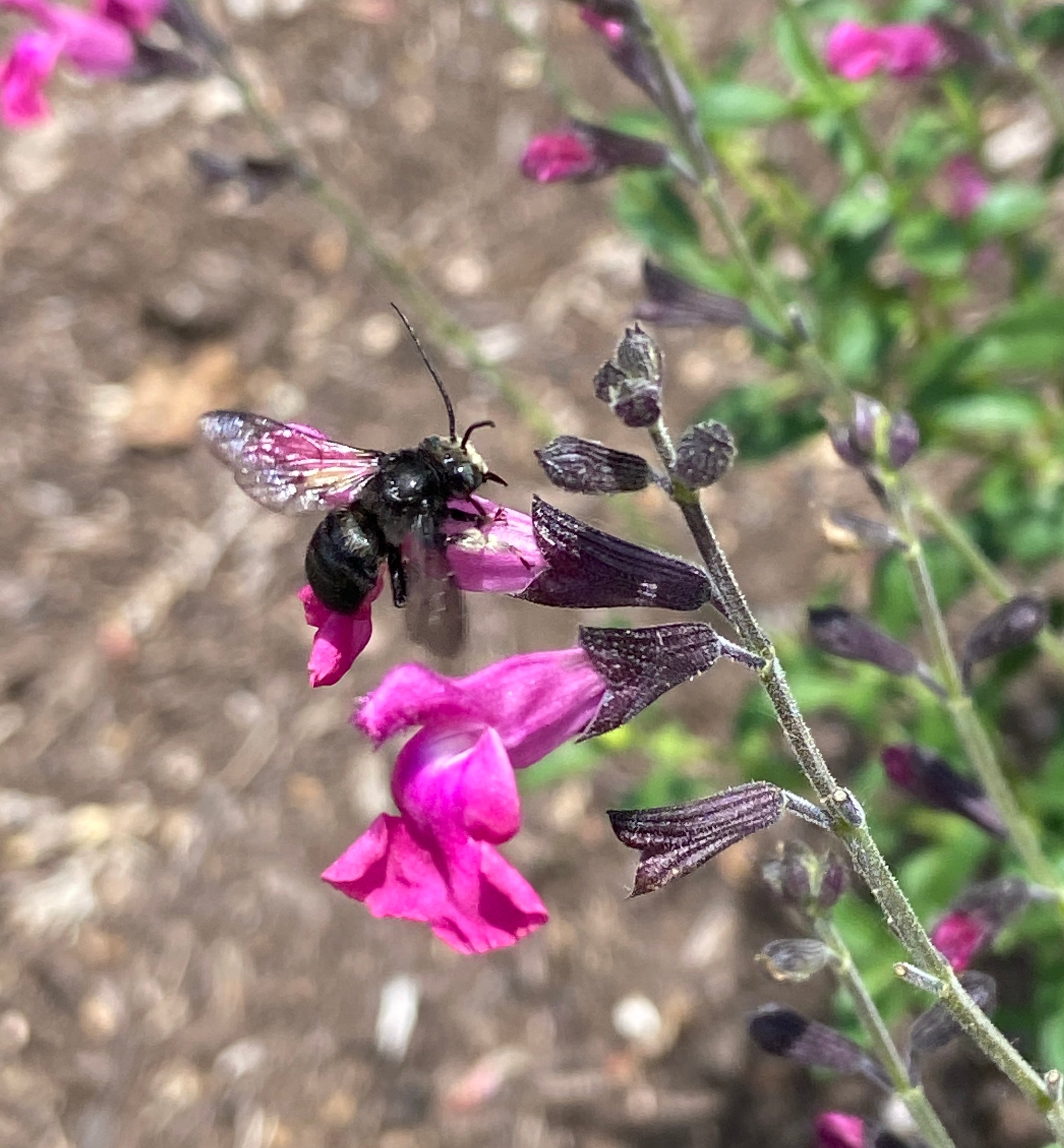
Longhorn bee. One of Leeah's study subjects.
How will being a Stengl-Wyer Fellow help advance your work?
The Stengl-Wyer Fellowship is giving me a lot of flexibility to pursue the aspects of my research that I’m most excited about but are not quite finished!
A lot of the work at the beginning of my graduate school experience involved lab based work with bumblebees since they are so convenient to work with and you can really understand the mechanisms of effects with controlled lab set-ups, but how bees truly interact with their environments is difficult to capture in simplified lab experiments. The two projects I’m wrapping up are aiming to capture a broader scope than would be possible with lab based studies.
The first project involves comparing pesticides detected across different potential routes of exposure (nectar, pollen, and soil) to what we detect in whole bees (social honeybees and solitary squash bees). We have a lot of samples from many conventionally managed pumpkin farms from west Texas, which will allow us to understand if anything we’re detecting contributes to the abundance of the different bee species that we have recorded. This is letting me gain experience with applied pesticide work in the context of real-world functioning agroecosystems.
The second project is about comparative brain morphology across longhorn bee species that vary in diet breadth - from very generalist species that forage on many different plants to specialists that focus on a single genus. We might expect that species that are more specialized (foraging from many fewer plant species) process information about floral traits differently. By leveraging the incredible diversity of species around us to compare brain morphology we can begin to understand some of these underlying differences.
Being a Stengl-Wyer fellow is giving me the ability to really pursue these broader questions in real world pesticide usage and in comparative cognition.
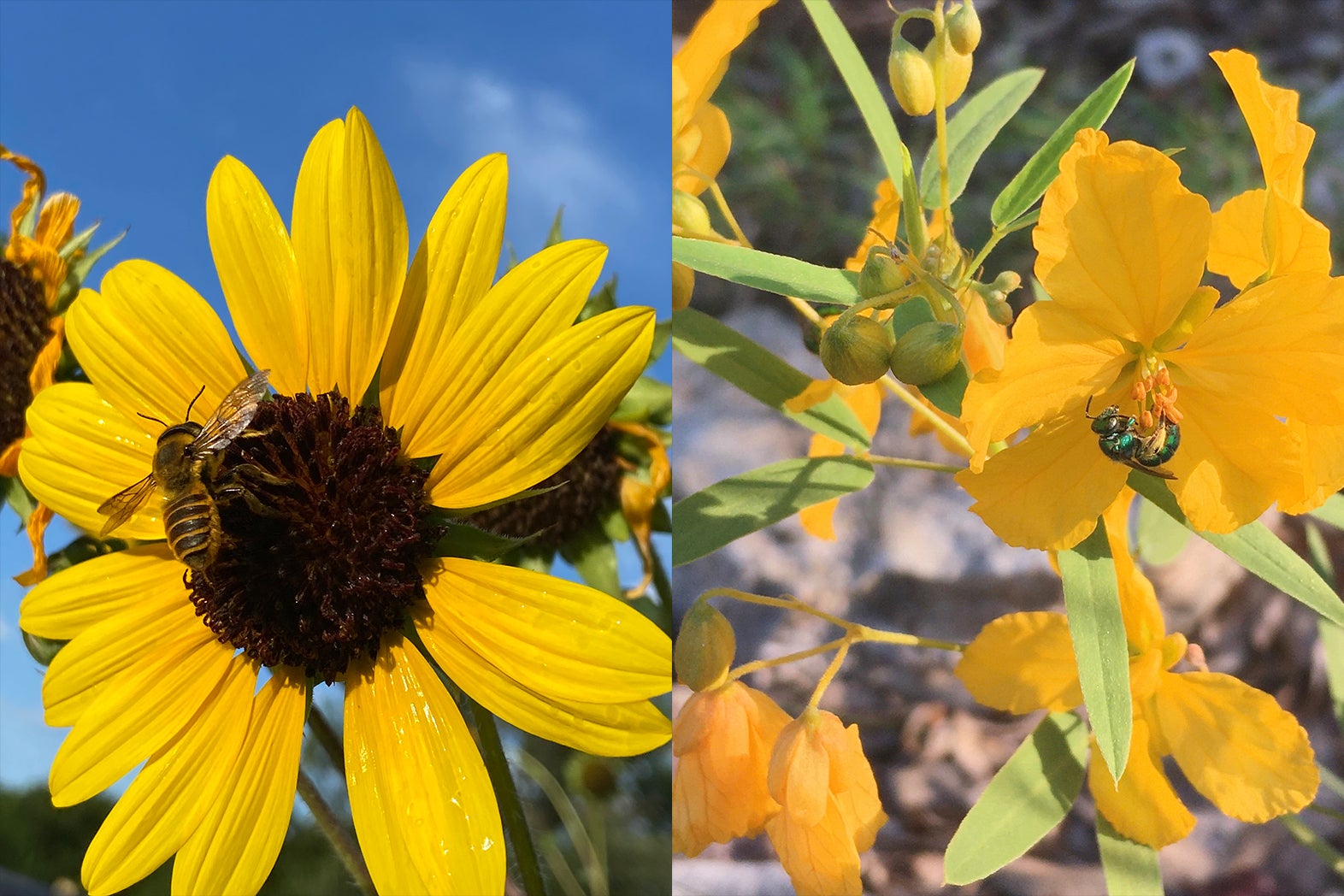
Two Texas bees. Left: Megachilidae. Right: Halictidae.
Where do you see your research agenda heading after UT?
Within this next year, I am hoping to pursue a postdoctoral position continuing to research insect behavior and its neurobiological underpinnings. Ideally, I want to expand to doing more comparative work across more bee species to better understand how ecological variation influences the brain and ultimately how bees process the information around them.
I love being involved in research projects and having opportunities to mentor students, so in the long run I’m hoping for a research-based position that lets me keep incorporating the things I love into my day-to-day.