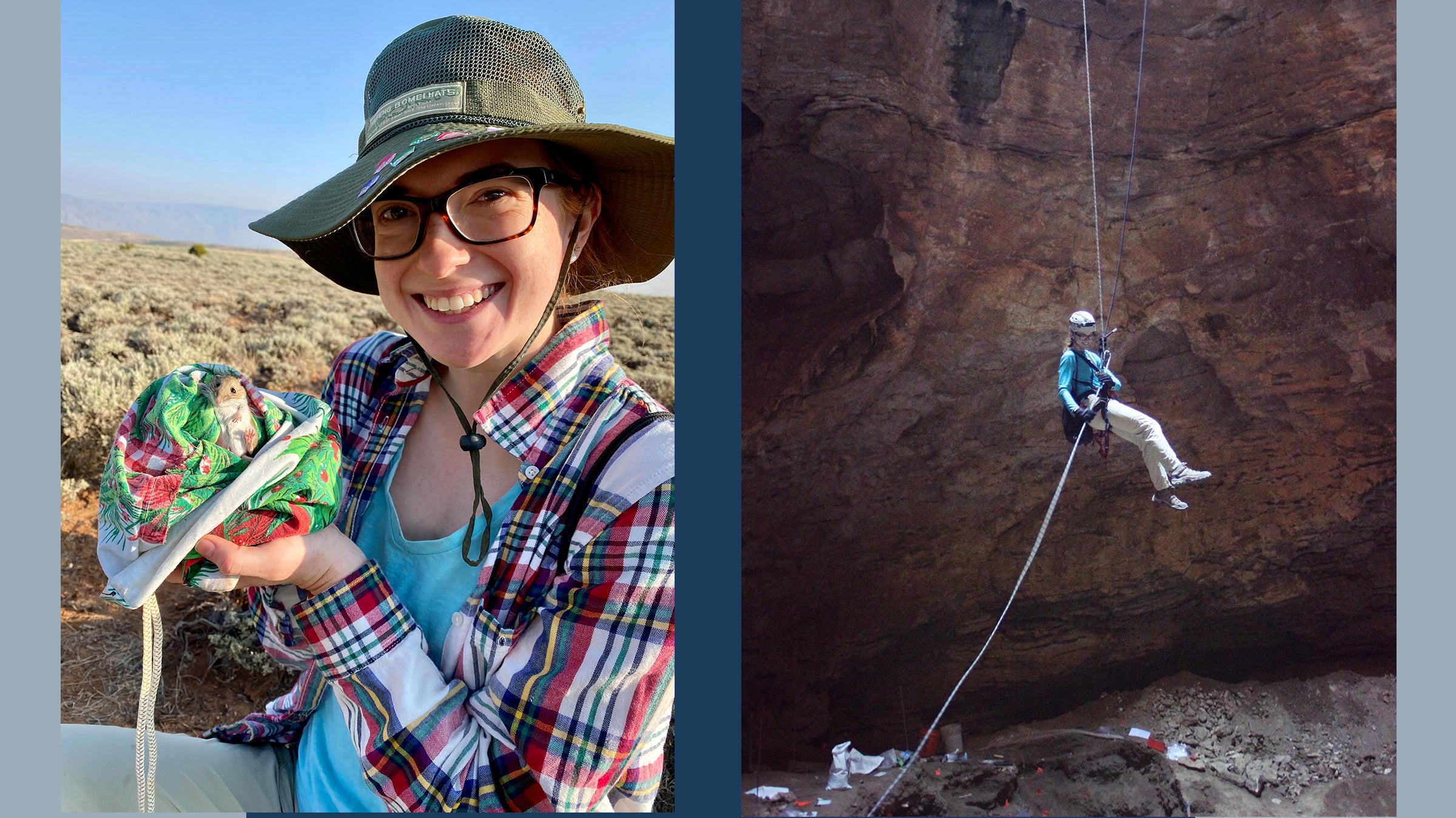
Left photo: Holding a deer mouse captured during our capture-mark-recapture field work in Wyoming. Right photo: rappelling into Natural Trap Cave.
Julia is a conservation paleobiologist who studies the impact of changing climate on small mammal communities. As a 2025 Stengl-Wyer Scholar, Julia works with Dr. Melissa Kemp to explore functional trait-environment relationships of small mammal communities from the Ice Age to the year 2100.
In this Q&A, Julia talks about her education background and early research, the directions they lead her, and what she is now focusing on in her current work as a Fellow.
Tell us where you came from before UT, and what you studied then?
I was born and raised in Central Florida and received my bachelor’s degree from the University of Florida where I spent a lot of time working in the vertebrate paleontology collections at the Florida Museum of Natural History. I then received my master’s degree from East Tennessee State University before moving to Atlanta where I attended Georgia Tech for my PhD. I worked under Dr. Jenny McGuire studying small mammal (rodent and rabbit) communities through time. I was interested in how community dynamics including richness (number of species), evenness (distribution of species abundances), and functional traits (physical traits that enable a species to interact with their environment) within these communities shifted in response to changing climate across spatial scales. Most of my work focused on our field site in Wyoming called Natural Trap Cave which preserves a record of community changes over the last roughly 30,000 years.
You study how climate change impacts small mammal communities. Can you explain what this means, how you do this, and how you got interested in this focus?
All animals interact with their environment and are impacted by changes within those environments. This can include changes in temperature, precipitation, and vegetation for example. Modern climate change is causing rapid changes across environments, and I am interested in how animals respond at a community level. To do this, I utilize a method called ecometrics which looks at the functional trait-environment relationship. Specifically, I look at the relationship between tooth crown height and precipitation. In areas that are open and arid, herbivores evolve higher tooth crown heights (i.e. rabbits) to combat the wear on their teeth from consuming dust and grit on the vegetation whereas in more closed and wet environments, they tend to have lower crown teeth (i.e. chipmunks). We can model this relationship using modern climate data and species lists and then apply these models in deep time and estimate past climates based on community composition in the fossil record across sites. My current work looks to project these models into the future to better understand, given current community compositions, which communities will be more or less fit for future climate and anthropogenic trends.
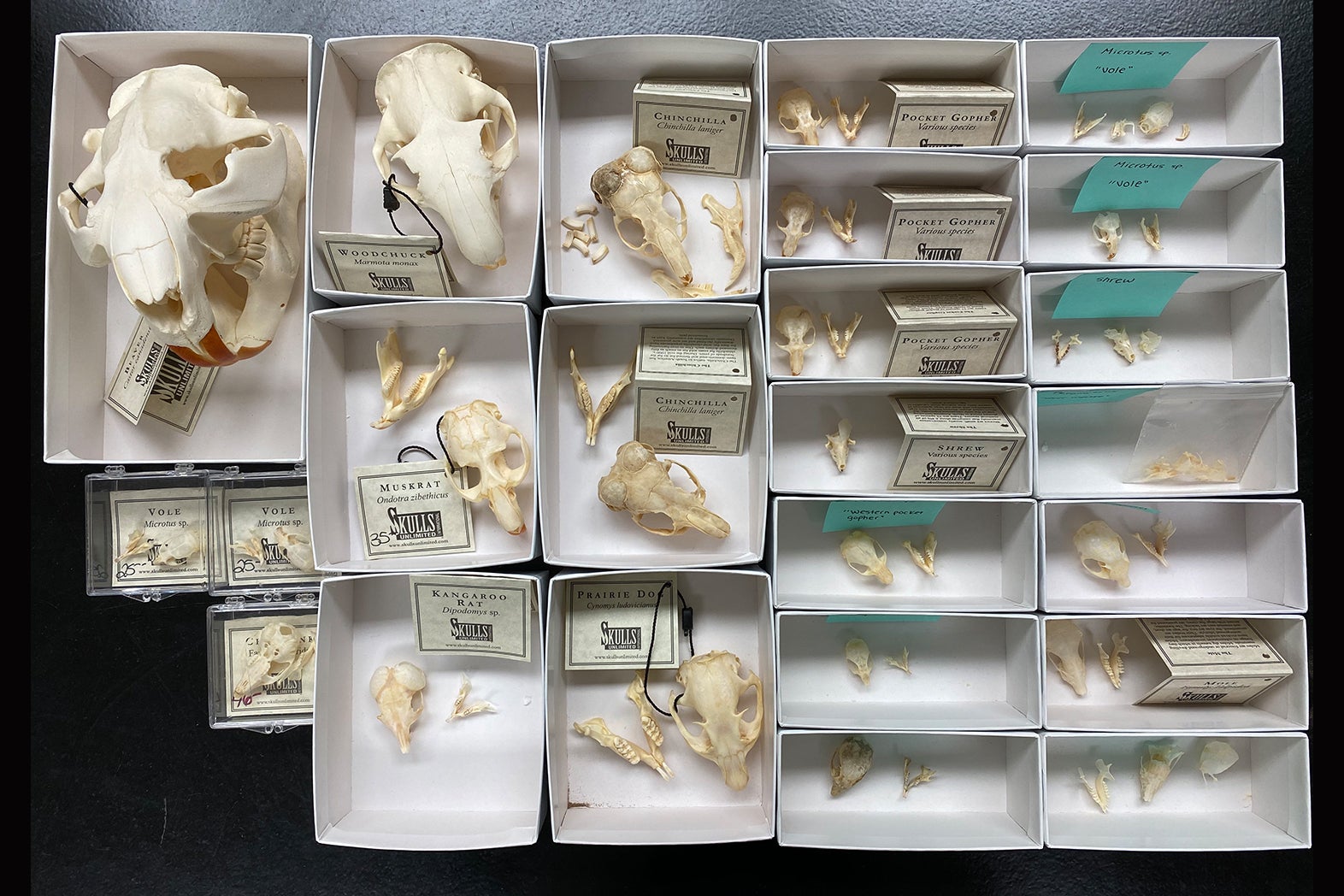
A variety of small mammal skulls in Dr. McGuire’s lab at Georgia Tech.
I became interested in studying small mammals during my masters when I learned how underutilized they are considering how specious and integral they are as a group. They are also very informative about localized changes since they have small home ranges. This is also when I became interested in conservation paleobiology. I always wanted my work to have relevance, and I believe that being able to use the fossil record and modern communities to better understand future ecosystems is really important and can help inform conservation priorities.
Does Texas present a unique situation, challenge or benefit for your research?
Working in Texas, specifically at UT, is beneficial to my research as I am able to work with some of the fossil sites across Central Texas that are housed in the Vertebrate Paleontology Lab at the J.J. Pickle Research Campus. Central Texas has such a rich fossil history across regions including the Edward’s Plateau which I have not focused on before. One aspect of my current research that I am very interested in is comparing small mammal community changes between the Southern Great Plains and the Northern Great Plains since the Pleistocene. I am working with Dr. Melissa Kemp here at UT Austin and Dr. Rachel Short at South Dakota State University to compare the fossil sites in Texas to fossil sites from South Dakota.
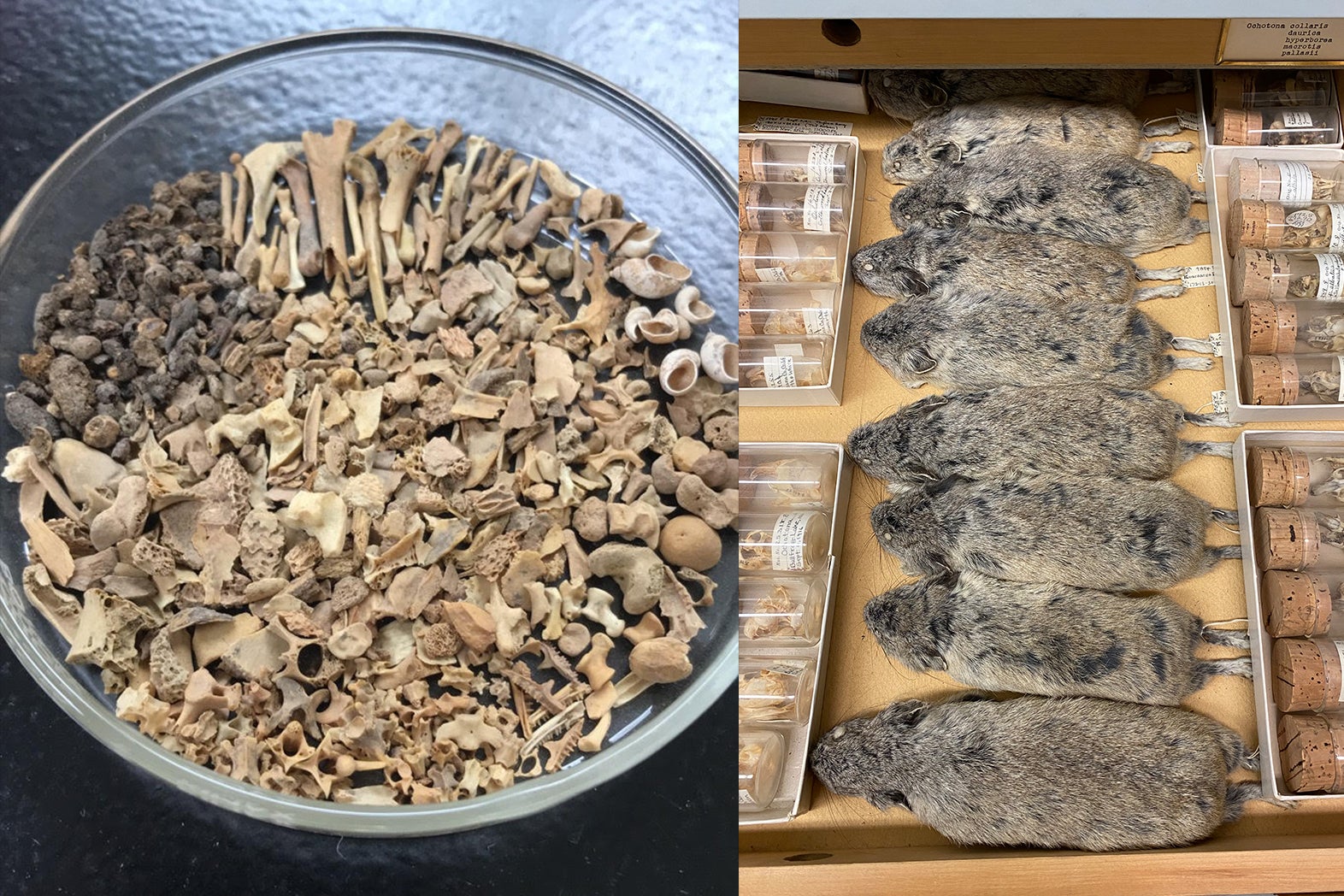
Left photo: a petri dish of fossils from Natural Trap Cave. Right photo: Pika from the Museum of Vertebrate Zoology at UC Berkeley.
How will being a Stengl-Wyer Scholar help advance your work?
Being a Stengl-Wyer Scholar presents an incredible opportunity to expand my network and be surrounded by other postdocs and graduate students working on some of the biggest questions in biology. I appreciate being part of a group that provides so much support, encouragement, and enthusiasm for our projects. I always find that by talking and working alongside people not directly in my field of paleontology that there are always things to learn and new methods to apply that I might not have thought about before. I will also be provided the opportunity to visit other museum collections to gather data as well as present my work and continue expanding my network at conferences.
Where do you see your research agenda heading after UT?
My long-term goal is to work as a museum curator. This would allow me to continue to combine my love of museums, research, and outreach. Museums have a wealth of knowledge within their collections units, and I want to use these valuable resources as well as further build up those collections through field work. I also believe they can be gateways to science for people of all ages and a fantastic way to share the discoveries we make through our research. I would like to continue to focus my work on small mammals, but I am also interested in exploring community responses across trophic groups including top-down or bottom-up changes in diversity metrics like richness, evenness, and functional diversity. Ultimately, if I can keep asking and answering interesting conservation-based questions and sharing my passions with the public I will consider it a win.
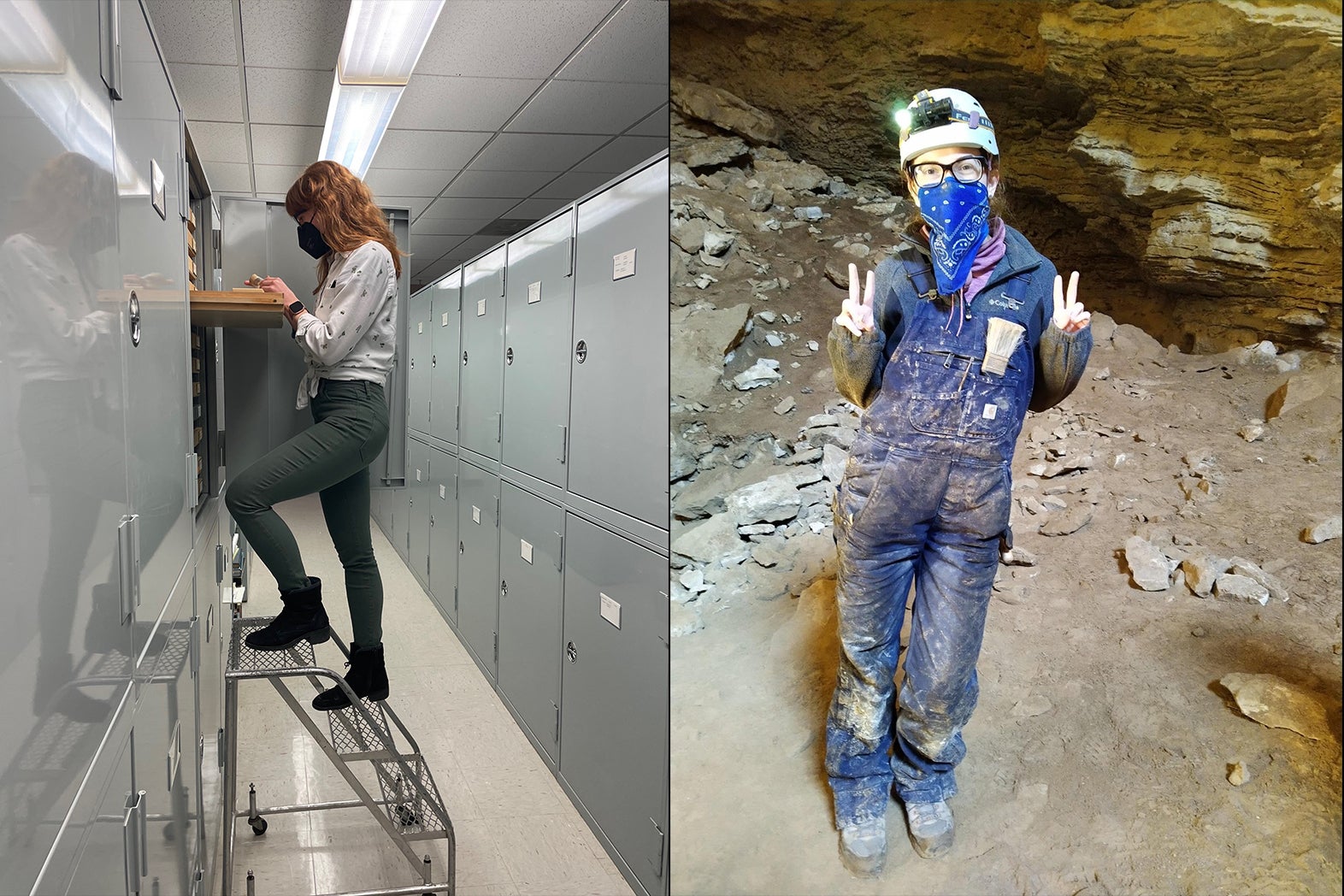
Left photo: looking through the collections at the Museum of Vertebrate Zoology at UC Berkeley. Right photo: in Natural Trap Cave after a day of crawling through mud looking for fossils.