Discovery of New Parasitic Plant Interaction by Stengl-Wyer Program Alumna
Liming Cai, a former Stengl-Wyer Scholar, has discovered a new parasitic plant interaction with foundational research she began at the University of Texas at Austin.
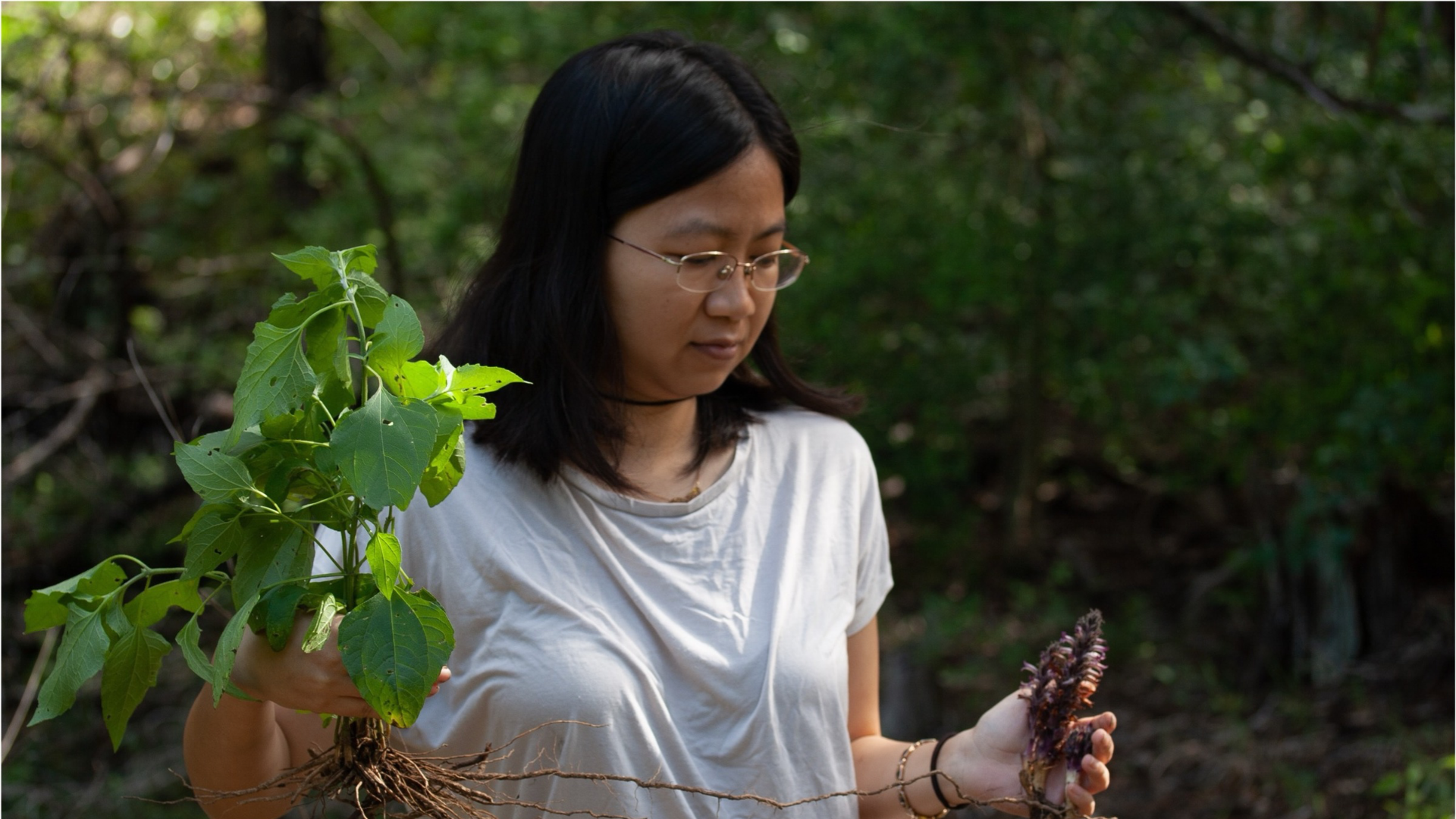
Liming holding a host-parasite plant pair connected by root tissue and haustoria. Photo credit: George Yatskievych.
Research that began here at The University of Texas at Austin has led to the discovery of an underground species interaction that was hidden in plain sight.
A new genetic analysis tool developed by Liming Cai, a former Stengl-Wyer Scholar and current Assistant Professor of Biology at the University of Florida, published a paper that has uncovered evidence of a previously undocumented parasitic relationship between two plants in New Caledonia, a group of islands about 750 miles east of Australia.
Cai began her research at UT Austin as a postdoctoral scientist in the Stengl-Wyer Scholar Program in 2021, a fellowship funded by the Stengl-Wyer Endowment that offers postdoctoral researchers an opportunity to pursue a fully funded independent project. During her time as a Stengl-Wyer Scholar, Cai investigated the ecology and evolution of parasitic plant interactions by analysing horizontal gene transfer (HGT), a phenomenon in which genetic material is passed between two individuals outside the “vertical” transmission of DNA from parent to offspring.
According to Cai, plants frequently take up alien DNA from the environment through horizontal gene transfer from a variety of sources including bacteria, fungi, and other plants. Interactions like plant parasitism leave unique genetic footprints that allow researchers to infer interactions from DNA sequences directly. However, identifying alien DNA and sources of horizontal gene transfer can be challenging.
Cai worked closely with the Billie L. Turner Plant Resources Center, utilizing the center’s extensive collection of preserved parasitic plant specimens to conduct her postdoctoral research. The preserved specimens provided DNA samples she could use to analyze horizontal gene transfer and subsequently laid the groundwork for Cai to develop a new genetic analysis program that identifies sources of HGT in plant genomes called HGTScanner.
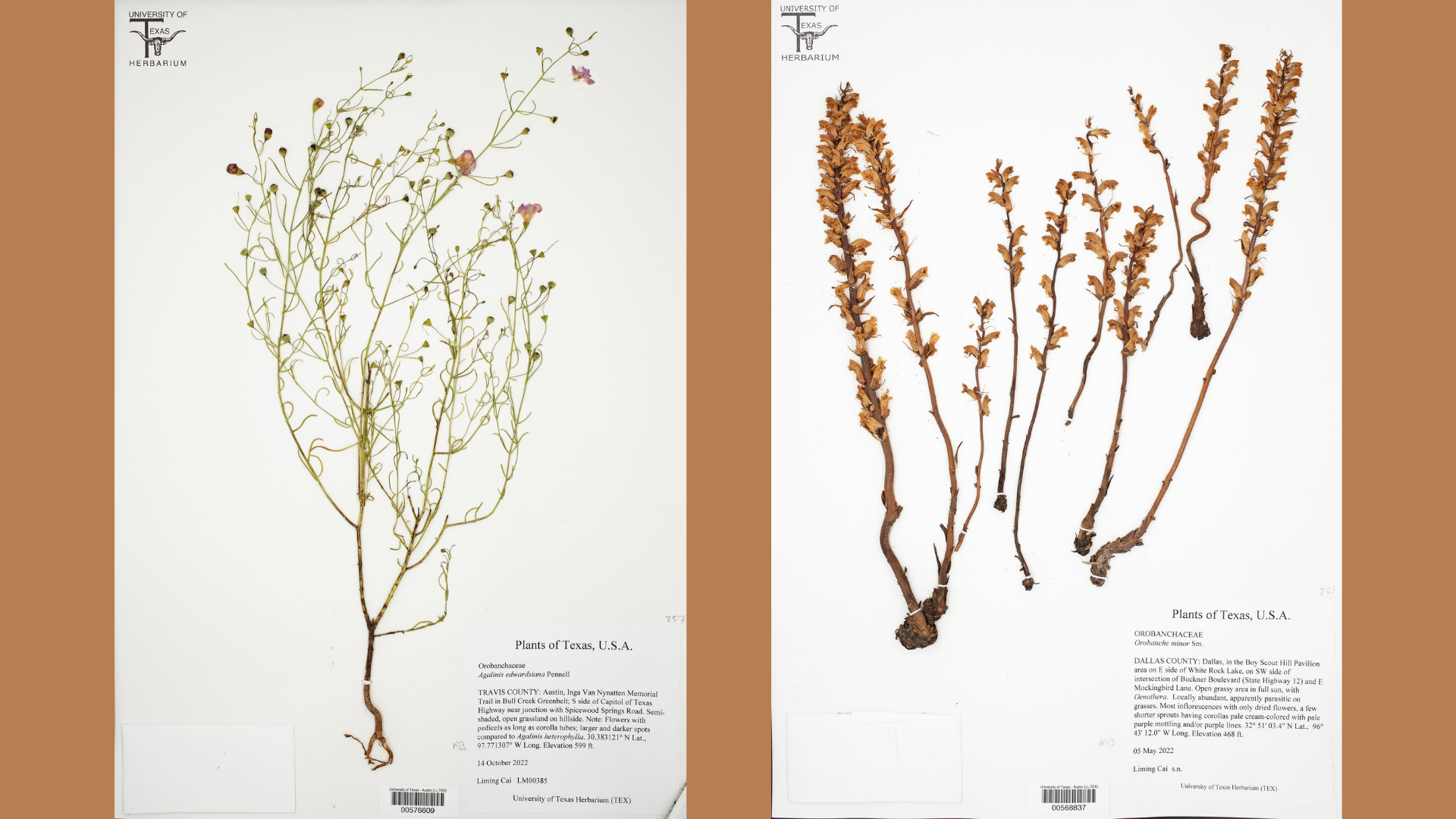
Preserved specimens at Billie L. Turner Plant Resources Center of the parasitic plants in the Orobanchacaea family Cai collected for her postdoctoral research project.
According to Billie L. Turner Plant Resources Center curator George Yatskievych, botanists are always seeking new ways to expand the potential uses of herbarium specimens. Cai’s work with the center is an example of how herbaria serve both as a repository for vouchers to document research and as a source of small fragments for morphological, anatomical, and genetic analyses.
Now as an Assistant Professor at the University of Florida leading her own lab, Cai tested HGTScanner with publicly available DNA data of the oldest living ancestor of flowering plants, a native New Caledonian shrub called Amborella. The program detected large amounts of alien DNA in the genomes of Amborella that belonged to Hachettea, a parasitic plant that extracts nutrients from its hosts through underground rootlike structures.
This discovery was surprising because Cai could find no previous record of the two plants interacting, despite both plants being endemic to New Caledonia.
“I looked up everything I could find in library, online, and from digitized specimens to see if there is any note on Amborella being the host of Hachettea,” Cai wrote. “Nothing. There is nothing in writing that connects these two plants together.”
Cai then came to the realization that she had discovered a parasitic relationship between these two plants without actually observing them in the field before.
“Darwin saw the star orchid and predicted a long-tongued pollinator; I had just predicted an ‘underground’ parasitic relationship between two New Caledonian plants, based on several thousand base pairs of dead, alien DNA in their genomes.” Cai remarked.
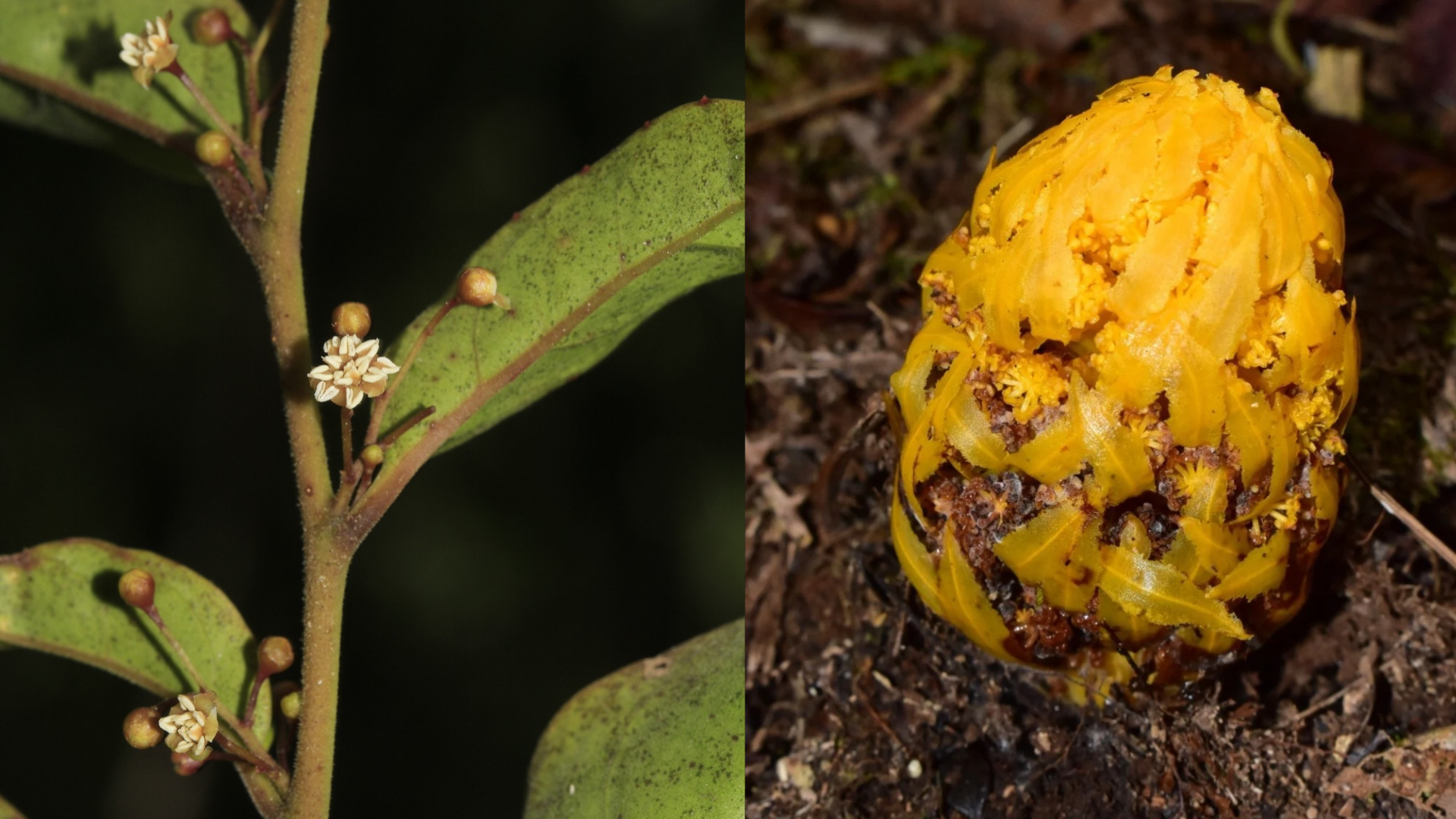
Amborella trichopoda (left) and Hachettea austrocaledonica (right) grown separately.
This exciting observation highlighted how HGTScanner can contribute to scientific discovery, and Cai hopes that her tool can be continually used and improved upon by others in the scientific community.
“I hope eventually that it can stimulate people’s enthusiasm to look at these alien DNAs and interpret their evolutionary history, their ecological values, and then perhaps their functional values,” Cai said.